


Beyond Blue invites you to dive into the Pacific Ocean — but forgets to tell a story
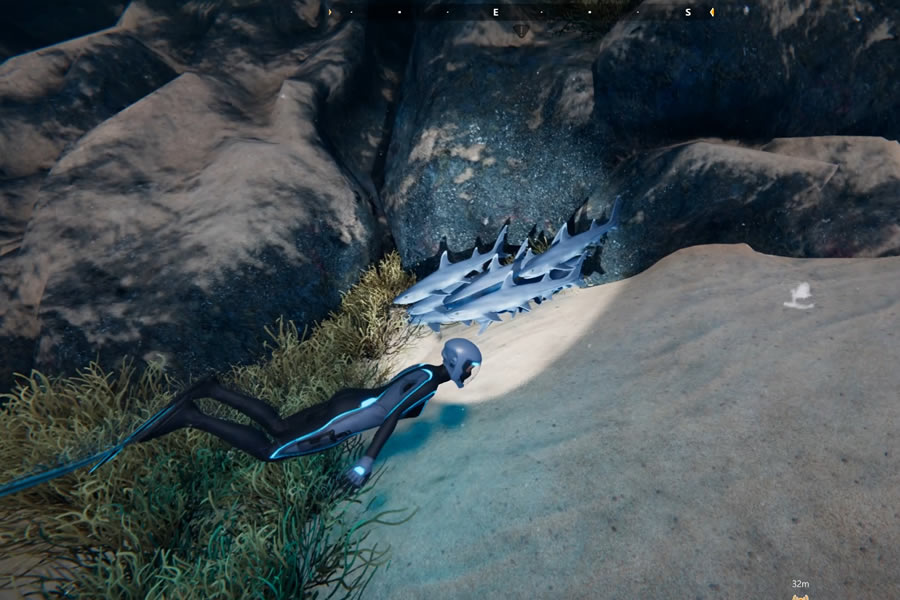
This third-person diving simulator from E-Line Media, developed in collaboration with scientists and the BBC Blue Planet II production team, launched with the ambition of blending edutainment and compelling storytelling. The science side succeeds; the narrative, however, stays in the shallows.
Marine biologist Mirai and eight dives into the western Pacific
Beyond Blue is a third-person diving simulator set in the waters of the western Pacific Ocean. The player takes on the role of Mirai, a marine biologist tracking a pod of whales and documenting the creatures of the deep. The campaign consists of eight dives, each functioning as a self-contained chapter. A full playthrough takes around three hours; between dives, Mirai returns to a submarine that serves as a hub for dialogue, phone calls to family, and supplementary materials.
Marine biologists, oceanographers, and members of the legendary BBC Blue Planet II documentary team were all involved in development. This approach gave the game a dual ambition: to entertain and to educate at the same time. For a project sitting at the intersection of video game and popular science film, that is an expectedly high bar to clear.
How each dive works
Each mission begins with Mirai swimming up to an electronic buoy that marks underwater creatures on the map. From there, the player is free to follow waypoints or explore the realistically recreated environments at their own pace. Upon finding a target creature, a small drone can be deployed for a detailed inspection, recording physical characteristics and logging data.
The controls feel fluid and comfortable even with a keyboard and mouse. Gliding through the water delivers an almost tactile sense of pleasure — one of the key strengths of a simulator of this kind.
The “submarine, conversation, dive, repeat” gameplay loop
The gameplay loop quickly becomes predictable: return to the submarine, discuss findings with colleagues, call family, dive again. The repetition is partially offset by a species database with creature descriptions, short scientific notes on the onboard tablet, and dialogue that fleshes out the characters.
Deep-sea trenches impress; the open ocean disappoints
Locations vary considerably in density and atmosphere. One of the most striking dives sends the player into a labyrinth of deep-sea trenches without a map: rocky corridors and complete uncertainty generate an almost adventure-like tension. The opposite extreme is the open-ocean level, where nothing surrounds you but a blue haze with no visible landmarks or events.
The central paradox of Beyond Blue’s visual world is this: for all its environmental realism, the ocean rarely feels like a space teeming with life. Compared to the fantastical worlds of Abzu or the alien depths of Subnautica, even the most populated locations here feel sparse.
Silence, sperm whales, and a live stream without adrenaline
Encounters with sperm whales, hammerhead sharks, and squid that resemble alien creatures are presented without any sense of threat. The game is consistently meditative. Mirai and her team conduct a live stream of their dives, and the constant commentary from colleagues explains what is happening around them and why each scan matters. These remarks occasionally feel a little performed, but on the whole they give the player’s actions a sense of purpose.
The ocean without a scuba tank
The underwater world has long captivated people, yet descending into the ocean’s depths is not something everyone can do. Health limitations, the cost of equipment and training, distance from warm seas, or simple fear of the deep all stand in the way. For many, games like Beyond Blue offer a way to experience the joy of diving without leaving home. Their simplicity and unhurried pace place such projects close to online games with bonuses, where the appeal lies not in tension but in the chance to relax and enjoy the process.
Finding entertainment of this kind is easy today, and some of it is distributed entirely free through digital storefronts via promo codes and promotions. The team behind www.nodepositbonusesnz.com, which tracks gaming bonuses, notes that such games span a wide range of themes and genres — from meditative simulators to puzzles and adventures. And if they do not always deliver a genuine sense of plunging into the underwater world, they certainly deliver one into the world of gaming. Beyond Blue performs its role as a calm guide honestly enough; it is the storytelling that raises far more questions.
Story threads never given room to breathe
The game touches on several themes:
- scientific work with whales and recording their songs;
- the consequences of deep-sea mining and ocean pollution;
- Mirai’s personal drama surrounding her grandmother’s Alzheimer’s disease;
- relationships within the team and connections with family.
The problem is that each of these threads is merely sketched out before being quickly dropped. The storytelling is never given room to breathe, and the delivery remains monotonous throughout the short runtime. E-Line Media’s previous project, Never Alone, wove its documentary segments together with an emotionally engaging narrative far more successfully.
Mini-documentaries as the project’s strongest asset
As the playthrough progresses, short video clips unlock in which real scientists discuss the state of the world’s oceans, climate change, and the species encountered in the game. The presentation is emotional, informative, and at times genuinely striking. The contrast with the main story is unmistakable: the energy and passion of the experts in these clips never flows through into the in-game events.
An interactive lecture about the ocean, not a dramatic adventure
Beyond Blue’s strengths are clear:
- realistic and enjoyable underwater swimming controls;
- a calm, exploratory structure free of pressure;
- edutainment value backed by a species database and expert video content.
Its weaknesses are equally apparent: a repetitive gameplay loop, occasionally empty locations, and story branches that never receive any development. Beyond Blue is best suited to those seeking a gentle, unhurried introduction to the underwater world in the format of an interactive lesson, rather than a gripping story with mounting tension.
Last Updated on October 16, 2026