


Lost at Sea? How Underwater Navigation Skills Can Save Your Dive
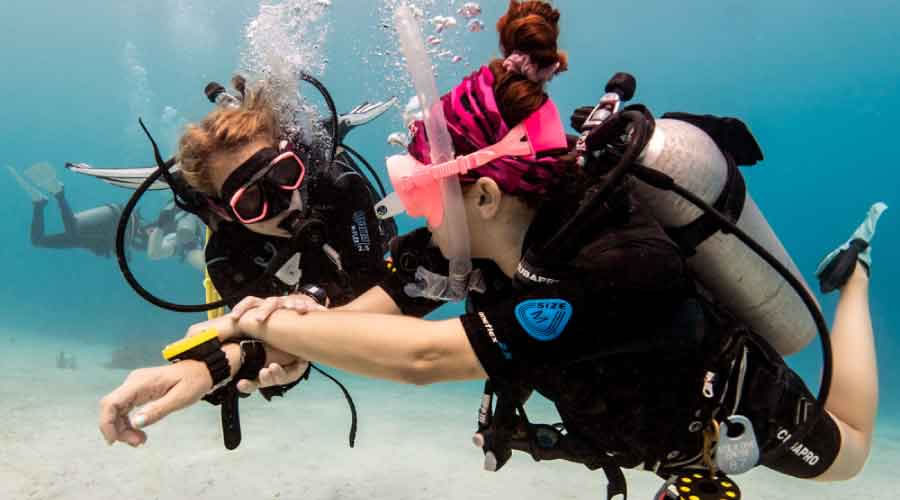
Every diver has a story. You drop below the surface following your dive guide, get absorbed in a passing sea turtle, look up, and — suddenly — the group is nowhere to be seen. The boat is somewhere up there, the reef looks the same in every direction, and the faintly uncomfortable realization sets in: you’re not entirely sure where you are. This is the moment underwater navigation skills stop being a theory exercise and start being genuinely useful.
Why Navigation Is Considered a Basic Skill — Yet Often Isn’t
Underwater navigation is technically introduced during the Open Water certification course, but the coverage tends to be brief. Most training agencies teach it more thoroughly as part of the Advanced Open Water Diver program. The result is that many certified divers — even those with dozens of logged dives — are operating with partial compass skills and a heavy reliance on either a dive guide or sheer luck.
That reliance works fine in familiar, well-marked dive sites with good visibility. But visibility drops. Currents shift. Guides get pulled toward other divers. The circumstances that make navigation genuinely necessary have a way of arriving unannounced.
The Underwater Compass: What It Is and How to Use It
An underwater compass functions on the same principle as any magnetic compass — it points to magnetic north regardless of where you’re facing. The key to using one correctly underwater is holding it level, parallel to your body, so the card can swing freely. Even a slight tilt gives you a false reading.
Before descending, set your heading: identify the direction you want to travel, align the lubber line (the fixed reference mark on the compass housing) with that direction, and rotate the bezel ring until it frames the compass needle. Now you have a locked course to follow. When it’s time to return, you simply follow the reciprocal bearing — if you swam north, swim south to get back.
A useful technique is to avoid staring at your compass constantly. Instead, take a bearing, identify a landmark on the reef in that direction (a coral formation, a rock, a distinctive sponge), swim to it, then take another bearing. This ‘leap-frog’ method keeps your eyes up and your awareness of the environment intact.
Natural Navigation: Reading the Underwater Environment
Underwater navigation isn’t only about the compass. Natural navigation — using environmental cues to orient yourself — is at least as important. Sunlight typically comes from a consistent direction at a given time of day; its angle underwater can help you determine roughly which way you’re heading. Sand ripples on the bottom tend to run parallel to the shoreline. Reef slopes can indicate depth and proximity to shore. The presence of certain fish species or coral types can be consistent enough to serve as identifiable landmarks once you know the site.
Before any dive at a new site, take a moment topside to observe the surrounding landscape. Note the position of the boat, the shoreline, prominent landmasses. Then, upon descending, turn around and look back at your entry point — the underwater view from that angle often looks completely different and is worth memorizing.
Measuring Distance: Kick Cycles and Time
An underwater compass tells you direction; it doesn’t tell you distance. To know how far you’ve traveled, divers typically use one of two methods. Kick cycles involve counting complete fin cycles (one full up-and-down kick equals one cycle) to estimate distance — each diver’s kick covers a slightly different distance, so it helps to calibrate yours in a known environment before relying on it. Time is an alternative: at a consistent swimming pace, you can estimate roughly how far you’ve traveled based on elapsed time.
When in Doubt, Stay Calm
Disorientation underwater triggers a stress response that consumes more air than anything else. The best thing you can do if you feel genuinely lost is stop, slow your breathing, and think. Check your compass, check your depth, look for reference features. In open water with no visibility, deploy your surface marker buoy (SMB) and ascend slowly along it. Surfacing isn’t failure — it’s a navigation tool. And being on the surface with a visible marker is almost always safer than staying underwater and spiraling deeper into confusion.
Mastering underwater navigation skills is worth the effort. They make every dive more relaxed, more efficient, and more genuinely adventurous — because when you know how to find your way back, you can afford to go a little further.
Last Updated on April 16, 2026